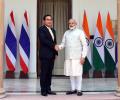
Thailand's importance to India's Act East policy is too significant to be overlooked.
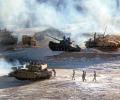
India's national security strategy needs to be revised periodically since the global and regional geopolitical situation is dynamic, points out Commodore Venugopal Menon (retd).

Cricketer-turned-politician Imran Khan on Friday night said he told Prime Minister Narendra Modi to expect sabotage by "vested interests", but stressed that talks between India and Pakistan should go on "uninterrupted".

'Difficult issues should not be brushed under the carpet, but should be raised upfront, particularly by India. While engagement and dialogue are always welcome and desirable, there should be some tangible results. Mere signing of agreements, MoUs, joint declarations are not enough.'

As disputed South China Sea witnesses increased Chinese influence, Vietnamese Prime Minister Nguyen Tan Dung on Monday pitched for India's "active support" to peacefully resolve all disputes and sought its greater linkages across the region.

Ahead of his talks with the Emirati leadership, Prime Minister Narendra Modi has said the Gulf region is vital for India's economic, energy and security interests.

Carter has said India's designation as a 'major defence partner' would allow the US to cooperate with it --

'That the two sides allowed such a situation to arise exposed the level of inaction and inefficiency in China-India border management.' 'The Modi-Xi meeting in Xiamen initiated a process to to avert such contingencies in the future.'

Terrorism and Afghanistan were the focus points of Prime Minister Narendra Modi's talks with Uzbek President Islam Karimov on his first visit to Central Asia.
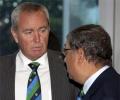
The first day of the International Cricket Council's Board meetings concluded in Dubai on Tuesday with unanimous support for a set of principles relating to its future structure, governance and financial models.

On her last day as India's envoy to the United States, Ambassador Nirupama Rao was felicitated by the Barck Obama administration at the State Department on Monday, with US Secretary of State John F Kerry thanking her for her service toward furthering the strategic partnership between the two nations.

Being a pragmatist Modi is not likely to give preference to China over Japan. Both security and economic aspects are likely to shape Modi's decision in terms of engaging the two biggest economies of Asia, says Sana Hashmi.
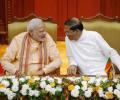
'What we have heard from the Sri Lankans is their desire to have a foreign policy that allows Sri Lanka to best advance its own interests rather than a foreign policy that relied solely on one relationship.' 'We think this is an attitude that makes a lot of sense. India and Sri Lanka have many areas of shared interests, and it's certainly welcomed by us to see that deepening of those ties.'

The joint statement issued after Prime Minister Narendra Modi and President Barack Obama's first-ever summit is high on intent and ambition. Notably missing from the statement is India's refusal to be America's partner in its war against ISIS.

Trade between India and Indonesia stands at $20 billion.
We see none of the euphoric build-up customary to India's encounter with US presidents in recent times. This gives Modi wriggle room to work on the much-needed reset of India-US ties.

"We are committed to building a new India. We have to do this as early as possible," he said.

'Pakistan has responded with appropriate contempt -- hrowing our national dignity into the waste paper basket.'

The prime minister and president stated their intention to expand defence co-operation to bolster national, regional and global security.
Even as the United States snuggles closer to India with the thinly veiled objective of containing China, the Indian strategy is to avoid alienating either nation.

India comes under attack over religious intolerance, human trafficking and slavery at a Senate Foreign Relations Committee hearing.

It was clear in Brunei at the 8th East Asia Summit that China doesn't want the South China Sea issue to even dominate the discussion, reports Sheela Bhatt, who is part of the prime minister's media contingent to the summit

'The US wants Modi to succeed because we want India to succeed. For our part, when India thinks of its partners in the world, we want it to think of the US first. That means positioning our country as the preferred provider of the key inputs that can help to propel India's rise.' 'The meeting between Modi and Obama is, and must be, an opportunity for true strategic dialogue -- not a scripted exchange of talking points, but an open discussion of the big questions. What kind of world do we want to live in? What are our true priorities? And most importantly, why does this partnership still matter?'

Prime Minister Narendra Modi, who recently completed one year in office, has, in an exclusive interview with Smita Prakash, editor, ANI, said the opposition alleging that his government is a "suit boot ki sarkar" is definitely better and more acceptable than being labelled a "suitcase" (ki sarkar), and satirically added, that after ruling for sixty years, the Congress has suddenly remembered the poor.
